
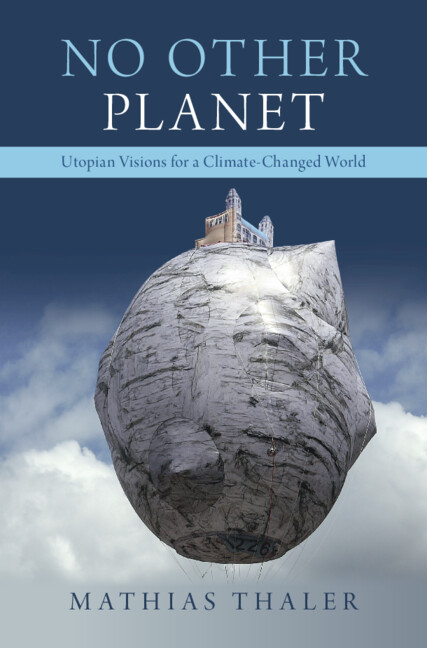
Book page at Cambridge University Press
Shortlisted for the PSA WJM Mackenzie Prize 2023, awarded each year to the best book published in the entire field of political science.
Short Description
Visions of utopia – some hopeful, others fearful – have become increasingly prevalent in recent times. This book examines expressions of the utopian imagination with a focus on the pressing challenge of how to inhabit a climate-changed world. Forms of social dreaming are tracked across two domains: political theory and speculative fiction. The analysis aims to both uncover the key utopian and dystopian tendencies in contemporary debates around the Anthropocene; as well as to develop a political theory of radical transformation that avoids not only debilitating fatalism but also wishful thinking. No Other Planet juxtaposes theoretical interventions, from Bruno Latour to the members of the Dark Mountain collective, with fantasy and science fiction texts by N. K. Jemisin, Kim Stanley Robinson and Margaret Atwood, debating viable futures for a world that will look and feel very different from the one we live in right now.
Key Contributions
- By bringing political theory, utopian studies and the environmental humanities into a conversation with one another, this book reveals original and illuminating perspectives on what it means to inhabit a climate-changed world.
- Through an in-depth analysis of key authors in political theory, No Other Planet provides a systematic and comprehensive defense of social dreaming against both left- and right-wing skeptics.
- By unpacking how utopian theory-building and storytelling can become mutually illuminating, this book demonstrates that contemporary science fiction and fantasy authors, such as N. K. Jemisin, Kim Stanley Robinson and Margaret Atwood, meaningfully contribute to the ongoing debate around our climate-changed world.
Excerpt
Podcast Interviews
- New Books Network: https://newbooksnetwork.com/no-other-planet
- Political Theory Review: https://www.podomatic.com/podcasts/thepoliticaltheoryreview/episodes/2023-05-16T09_27_38-07_00
Endorsements
“No Other Planet synthesises astute theoretical analysis, bold imagination and an acute consciousness of the stakes for scholars writing about the climate crisis to engage readers in the transformative possibilities of utopian thought, art and action. Dispelling both tired dismissals of utopia as wishful thinking, and their counterpart in resigned fatalism, Mathias Thaler demonstrates how different utopian imaginations, in theory, in fiction and in the prefiguration of activism, can estrange, galvanise and caution those for whom the future seemed fixed by the past and present. In this sense, while never overstating the difference that theory can make in the face of our planet in peril, Thaler has written a book that allows his readers to recognise this one, only planet as one whose future our care, attention and imagination might make a difference.”
Danielle Celermajer (University of Sydney)
“Thaler offers a challenging vision for our times in applying varying traditions of utopian enquiry to the prospect of imminent environmental catastrophe in the coming decades. Commencing from the premise that utopianism involves the “education of a desire for being and living otherwise”, he contends that this process demands re-imagining who we are and where we are going. No mere wishful thinkers or builders of castles in the sky, utopians vindicate the imagination in offering us visions of prospective alternative worlds which lift us beyond the constricting horizons of the everyday and suggest solutions to the deadly scenario looming before us. This is a provocative, refreshing, and welcome addition to the literature on utopianism, to current proposals about solving global warming, and to the revival of utopian thinking itself.”
Gregory Claeys (Royal Holloway, University of London)
“Our ecological predicament can seem overwhelmingly grim. Mathias Thaler’s deeply thoughtful book shows what speculative fiction can bring to understanding present-day crises, and the desire and impetus for ecological hope. Thaler resists clean-cut, easy solutions. Instead, utopian studies, environmental humanities, and political theory meet in this brilliant exploration of the social and theoretical tensions that arise when there is nowhere else to go, and where the flourishing of the radical imagination, in all its diversity, depends on supporting rather than papering over the faultlines.”
Davina Cooper (King’s College London)
Reviews
“The extensive analysis of the meanings of utopianism in No Other Planet is the most illuminating that I have come across in political theory. This is in large part a result of Thaler’s style and sensibility. He is a very generous interlocutor: rather than seeking to discredit or dismiss alternative viewpoints, or engaging in polemics with authors he disagrees with, he seeks out points of agreement or constructive elements that he can build on or incorporate into his own thinking, even as he is clear about what he rejects. As such, the book has an admirable cumulative synthetic quality, grounded in a view of scholarship as a shared endeavour rather than a blood-sport. It is an attractive scholarly virtue. Indeed it can be read as modelling some of the utopian openness and generosity that he seeks to diagnose and prescribe.”
Duncan Bell (Cambridge University) for the Centre for the Study of Governance and Society at King’s College London
https://csgs.kcl.ac.uk/book-review/mathias-thaler-no-other-planet-utopian-visions-for-a-climate-changed-world-cambridge-university-press-2022/
“Thaler’s innovative methodological framework and judiciously analysed examples effectively and powerfully demonstrate the value of thinking speculative fiction, political theory, and climate change together. The study, with this constellation of elements, sets out a research agenda that will no doubt spur other green political theorists to explore the world of speculative fiction. Given the political disruptions associated with the climate crisis, new ways of thinking are required – and the dreams of climate fiction writers, whether weird or wonderful, hopeful or apocalyptic, are an invaluable resource.”
Joe P. L. Davidson (Warwick University) in Environmental Politics
https://www.tandfonline.com/doi/full/10.1080/09644016.2023.2213135
“The book is an excellent example of cross-disciplinary work, bringing together political philosophy, insights from literary studies, and environmental humanities. In that respect, No Other Planet is an important work for scholars working across utopian studies as well as scholars working more broadly on utopian-thought in political philosophy and environmental humanities. Thaler’s theories of utopian fault lines open a productive line of enquiry with the potential for studies to investigate the other fault lines that underpin utopian literature.”
Ruth Houghton (Newcastle University) in Global Policy
https://www.globalpolicyjournal.com/blog/29/06/2023/book-review-no-other-planet-utopian-visions-climate-changed-world#_edn2
“As this overview suggests, No Other Planet covers an enormous amount of ground, drawing from an admirably wide range of texts and showing an impressive mastery of multiple literatures. This fits the book’s focus on the education of desire, since there are so many channels through which desire might be educated. It’s also an important way of decentering traditional approaches to political theory, showing that other ways of engaging with politics may illuminate our present circumstances better than the familiar tools of abstraction and generalization. In that way, the book is an exemplar of problem-driven interdisciplinarity and a model of how theorists can and should make use of cultural resources to understand our world.”
Benjamin L. McKean (Ohio State University) in Contemporary Political Theory
https://link.springer.com/article/10.1057/s41296-023-00644-2
“Thaler makes a compelling case for the importance of studying utopian visions in helping ‘us’ to figure out better ways of being, living and surviving the Anthropocene. He demonstrates an ability to render complex concepts and diverse literatures accessible, and weaves them together into a coherent albeit wide-ranging survey of utopian visions.”
Carl Death (University of Manchester) in Cambridge Review of International Affairs
https://doi.org/10.1080/09557571.2023.2248442
“How can utopianism inform a response to the climate crisis? Examining utopianism in political theory and speculative fiction, Mathias Thaler demonstrates how utopianism already functions in both genres. Through sensitive analyses of Bruno Latour; N.K. Jemisin; eco-modernists like Steven Pinker and Kim Stanley Robinson; and eco-pessimists like the Dark Mountain Collective and Margaret Atwood, Thaler shows not just the variety of utopianism but also how utopianism motivates readers toward action, even in what feels like dystopian times.”
Joel Alden Schlosser (Bryn Mawr College) in Political Science Quarterly
https://doi.org/10.1093/psquar/qqad101
“We will always need works which challenge and expand our perception of the possible, and both Claeys’ and Thaler’s books, therefore, have their value as guides to the other worlds of the imagination. They excel principally as commentaries on their respective sources, and between their fresh readings of familiar works and their attention to under-studied texts, they offer much that can enrich the nexus between political theory and the environmental humanities. This, however, is only one of their objectives, and perhaps not the most critical. Thaler and Claeys eventually return us to the familiar, endangered planet we call home, with the hope that it will look different: more precarious, more precious, but also replete with greater possibility. In doing so, Thaler’s and Claeys demonstrate the humanities’ enduring capacity to edify the political imagination, even when the issues at hand are unprecedented in history and unanticipated in our canonical texts.”
Matthew Benjamin Cole (Harvard University) in Contemporary Political Theory
https://doi.org/10.1057/s41296-023-00661-1
“It is an important virtue of this rich book that it aims at establishing an interdisciplinary dialogue between literary studies and social sciences, placing literature, and generally imagination at the same level with the rationality of social and political analysis. The book gives a thorough review of debates around utopianism in the 21st century and it also raises attention to the severity of the climate emergency.”
Zsolt Czigányik (ELTE University) in Freeside Europe Online Academic Journal
https://www.freesideeurope.com/articles/utopianism-and-climate-change-a-book-review-of-thaler-mathias-no-other-planet-utopian-visions-for-a-climate-changed-world-2022-119
“Drawing upon the utopian trope as manifested in theory and fiction, Thaler tackles the difficult question of how we can shape a future for humanity and for nonhuman lifeforms on a radically altered planet. His methodical analysis and critique of utopian ideas, and his innovative use of speculative fiction to shed light on and add depth to theoretical discussions on Earth and our future, constitute an important intellectual contribution to this critical debate.”
Nicole Rogers (Bond University) in Review of Politics
https://doi.org/10.1017/S0034670524000123
“No Other Planet is path-breaking in the sense that it creates a space within political theory for new ideas to emerge and be played with—ideas that have the potential to deparochialize the field and inspire readers to rethink our modes of relating. The sort of questions that arise after reading the book revolve around the direction in which political thought should move: what ideals, goals, and ends, if any, should political theory uphold in imagining posthumanist futures? How can we find direction through processes of estrangement and defamiliarization?”
Didier Zúñiga (University of Alberta) in Political Theory
https://doi.org/10.1177/00905917241291148
“No Other Planet ist eine reichhaltige Quelle für utopische Theoriearbeit und eine faszinierende Diskussion der menschlichen Aussichten im Anthropozän. Jeder, der an einer politischen Theorie des Anthropozäns interessiert ist, tut gut daran, sich damit zu befassen. Die Gelehrsamkeit und Vorstellungskraft, die in diesem Buch zum Ausdruck kommen, sind sowohl inspirierend als auch höchst informativ. Es ist eine intellektuell fesselnde Lektüre, die mit Sicherheit das Denken jedes Lesers über das Anthropozän beeinflussen wird.”
Darrel Moellendorf (Goethe-Universität Frankfurt) in Deutsche Zeitschrift für Philosophie
https://www.degruyter.com/document/doi/10.1515/dzph-2024-0046/html
“What could easily become a heady, jumbled rush of theories and observations is kept in line by Thaler’s tight structure, leaving a monograph that is engaging to read while synthesizing many competing or divergent strands of thought. […] We may ‘not yet possess a satisfactory account of utopian visions in and for our times’ (2), but Thaler is plotting a path forward for others to follow.”
Ashley S. Moser (Tacoma Community College) in Utopian Studies
https://muse.jhu.edu/pub/2/article/971821
 Mathias Thaler
You must be logged in to post a comment.